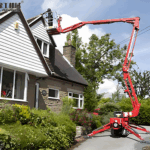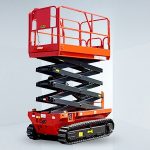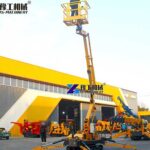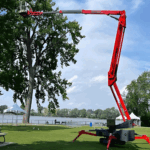


When conventional aerial lifts cannot enter a narrow jobsite, a spider aerial platform can provide a more flexible solution. Its compact tracked chassis, adjustable outriggers, and articulated boom allow operators to reach elevated work areas where space, terrain, or access conditions are challenging.
A spider aerial platform is designed for jobs that require high working reach without a large machine footprint. It can be used around buildings, in landscaped areas, on construction sites, and in other restricted-access locations where traditional truck-mounted platforms may be difficult to position.
YG offers compact spider aerial platforms with different working heights and configurations for construction, maintenance, tree care, industrial work, and other elevated-access applications.
Need a compact aerial platform for a difficult-access project? Contact YG for a suitable model and quotation.
What Is a Spider Aerial Platform?
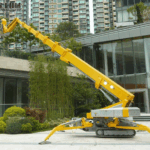
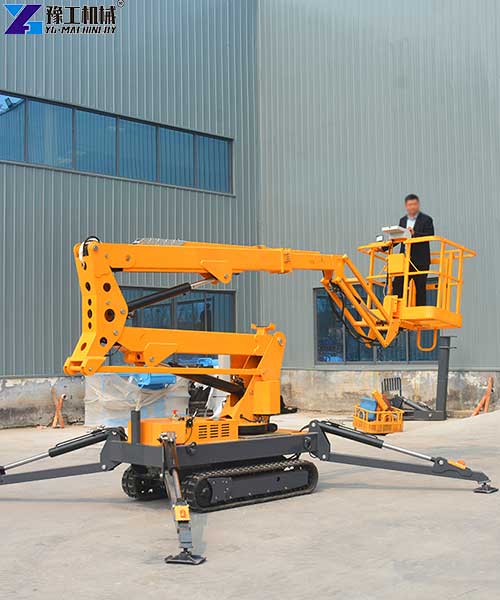
A spider aerial platform is a compact tracked aerial work platform designed to provide elevated access where conventional equipment cannot easily operate.
Unlike truck-mounted aerial platforms, it does not depend on a large road vehicle for mobility. The tracked chassis allows the machine to move across jobsites, while independent outriggers provide stable support during elevated operations.
The main components typically include:
- Tracked chassis for moving across different jobsite surfaces
- Adjustable outriggers for stable positioning
- Articulated boom for flexible vertical and horizontal reach
- Work platform for operators and tools
- Compact body for access through narrow entrances
- Hydraulic lifting system for smooth boom movement
This combination makes a spider lift particularly useful when the job requires high access in a confined or uneven working environment.
Why Choose a Spider Aerial Platform?
The main advantage is not simply working height. It is the ability to combine reach, stability, and compact access in one machine.

A spider aerial platform can help contractors deal with common problems such as:
- Limited entrance width
- Uneven or sloping ground
- Restricted setup space
- Indoor and outdoor access requirements
- Landscaped surfaces where heavy equipment is undesirable
- Elevated work around buildings and obstacles
For contractors who frequently move between difficult jobsites, this flexibility can reduce setup time and make elevated work more practical.
How Does a Tracked Spider Lift Work?
A tracked spider lift uses a crawler-type chassis for jobsite movement and deployable outriggers for working stability.
The basic operating process is straightforward:
Move → Position → Stabilize → Extend → Work
1. Move to the Work Area
The tracked chassis allows the machine to travel across the jobsite and approach the work location.
Its compact dimensions are particularly useful when access is restricted by doors, gates, landscaping, walls, or other obstacles.
2. Deploy the Outriggers
Once positioned, the operator deploys the outriggers and adjusts them according to the ground conditions.
The outriggers increase the machine’s support footprint and provide a stable base for elevated operations.
3. Extend the Boom
The operator controls the boom to reach the required working position.
Depending on the configuration, the articulated boom can move around obstacles and provide both vertical height and horizontal outreach.
4. Perform Elevated Work
After reaching the required position, workers can perform maintenance, installation, inspection, construction, or other elevated tasks from the work platform.
This setup gives operators a more controlled working position than relying on ladders or temporary access equipment.
Spider Lift vs Articulating Boom Lift
Choosing the right aerial access equipment depends heavily on the jobsite.
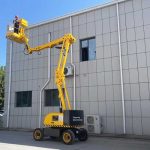
A large conventional aerial lift may offer excellent capacity and reach, but its size can become a problem when the site has narrow entrances, limited turning space, or uneven terrain.
| Narrow access | Excellent | Usually requires more space |
| Uneven terrain | Well suited with outriggers | Depends on model and ground |
| Horizontal outreach | Good | Excellent |
| Indoor/restricted access | Excellent for suitable models | More limited |
| Transport | Compact tracked design | Generally larger |
| Open construction sites | Suitable | Excellent |
A spider aerial platform is therefore particularly useful when access and positioning are more important than simply maximizing machine size.
For open roads or large outdoor jobsites with suitable vehicle access, an articulating boom lift may be a more practical choice, especially when greater horizontal outreach and flexible positioning around obstacles are required.


Applications of Spider Aerial Platforms
Spider aerial platforms are used across a wide range of industries where workers need safe access to elevated areas without bringing a large machine into the work zone.
Tree Care
Spider lifts can provide elevated access for arborists and landscaping contractors working in restricted gardens, parks, residential areas, and other locations.
For detailed applications involving pruning and tree maintenance, see our guide to Spider Lift for Tree Pruning.
Building Maintenance
A spider aerial platform can help workers access building façades, roofs, windows, signs, lighting systems, and other elevated areas.
Its compact footprint is useful around buildings where access for larger equipment is restricted.
Glass Installation
Installing or replacing glass at height often requires precise positioning close to a building façade.
The articulated boom allows the platform to approach elevated work areas while the compact chassis helps the machine operate in areas where conventional equipment may not fit.
Roof Work
For selected construction and maintenance projects, spider lifts can provide temporary elevated access around roofs, structures, and building edges.
The ability to position the machine using outriggers is especially useful where ground conditions or available setup space make larger equipment difficult to use.
Construction
Spider aerial platforms can be used for elevated installation, structural work, inspection, finishing, and maintenance tasks.
Their compact design makes them useful for projects where equipment must work around existing structures.
Industrial Maintenance
Factories, warehouses, plants, and other industrial facilities may have elevated pipes, lighting, ventilation systems, machinery, and structural components that require regular access.
A compact tracked platform can help reach these areas without requiring a large truck-mounted machine inside the facility.
Facility Maintenance
Hotels, shopping centers, public buildings, sports facilities, and commercial properties often need periodic work at height.
A spider aerial platform can be used for tasks such as lighting maintenance, signage work, inspection, and building upkeep.

Spider Aerial Platform Models
YG provides different spider aerial platform configurations to match different working heights and access requirements.
For example:
| YG-3 | Compact access | Low-height maintenance and restricted spaces |
| YG-5 | Medium working height | Building maintenance, installation, landscaping |
| YG-8 | Higher reach | Construction and elevated maintenance |
Actual working height, outreach, platform capacity, overall dimensions, and machine weight should be selected according to the specific model configuration.
For projects requiring a particular working height or access width, YG can recommend a suitable configuration based on your jobsite conditions.
Looking for a tracked spider lift for sale? Tell us your required working height, entrance width, horizontal outreach, and application. We can recommend the appropriate model.
How to Choose a Spider Aerial Platform?
The highest working height is not always the best choice. A suitable machine needs to match the actual access conditions and working requirements of the project.
Working Height
Determine the maximum height workers need to reach.
Leave enough operating margin rather than selecting a machine that can only reach the exact required height.
Horizontal Outreach
Working height alone does not determine whether the platform can reach the target location.
If workers need to reach over a roof, wall, tree, or other obstacle, check the required horizontal outreach as well.
Platform Capacity
Consider the combined weight of:
- Operators
- Tools
- Materials
- Installation components
Choose a platform capacity that provides an appropriate working margin.
Overall Width
For restricted-access projects, machine width can be more important than working height.
Measure the narrowest entrance, gate, corridor, or passage before choosing a model.
This is especially important for customers looking for a small spider lift for residential, commercial, or indoor projects.
Machine Weight
Ground bearing capacity should also be considered.
A lightweight machine may be preferable when working on sensitive surfaces or entering buildings, but the final selection should always take the actual ground conditions into account.
Ground Conditions
Consider whether the machine will operate on:
- Concrete
- Asphalt
- Gravel
- Grass
- Sloping ground
- Uneven terrain
The suitability of a spider aerial platform depends on the machine configuration, ground conditions, and correct outrigger setup.
Spider Aerial Platform vs Spider Boom Lift: Are They the Same?
In many product contexts, spider aerial platform and spider boom lift refer to the same general type of compact elevated-access equipment.
The terminology emphasizes different characteristics:
- Spider aerial platform highlights the elevated work platform function.
- Spider boom lift emphasizes the boom lifting mechanism.
- Tracked spider lift emphasizes the crawler chassis.
- Spider cherry picker is another commonly used market term.
For customers comparing different configurations, the important specifications are not the name itself but the working height, horizontal outreach, platform capacity, machine width, weight, and ground conditions.
For complete specifications and available configurations, see our Spider Boom Lift for Sale page.
Why Choose YG Spider Aerial Platforms?
For contractors, the biggest challenge is often not finding a machine that can reach the required height. It is finding one that can reach the work area and operate safely within the site’s physical limitations.
YG spider aerial platforms focus on this difficult-access requirement.
Compact Access
A narrow chassis helps the machine enter restricted areas where larger aerial equipment cannot easily operate.
Flexible Positioning
Adjustable outriggers allow the machine to be positioned for different working conditions and available setup spaces.
High-Reach Capability
The boom system provides elevated access while maintaining a relatively compact footprint.
Tracked Mobility
The crawler chassis allows the machine to move around jobsites without relying on a truck-mounted platform.
Multiple Applications
One machine can support various elevated tasks, including maintenance, construction, installation, inspection, landscaping, and facility work.
Factory-Direct Supply
YG Machinery provides direct factory support, model selection, customization, and technical assistance for international customers.

Spider Aerial Platform for Difficult-Access Jobs
A spider aerial platform is most valuable when conventional aerial equipment becomes difficult to use because of limited access, uneven ground, restricted setup space, or obstacles around the work area.
Instead of choosing equipment based only on maximum working height, consider the complete jobsite: entrance width, working height, horizontal outreach, platform capacity, machine weight, and ground conditions.
Whether you need a compact spider lift for building maintenance, a tracked spider lift for construction, or a high-reach platform for specialized work, choosing the right configuration can improve both access and operating efficiency.
Need help choosing a spider aerial platform? Contact YG with your required working height, access width, and application for a suitable model recommendation.
FAQ about Spider Aerial Platform
What is a spider aerial platform used for?
A spider aerial platform is used for elevated work in locations where conventional aerial lifts may have difficulty accessing or positioning. Common applications include building maintenance, construction, glass installation, facility maintenance, tree care, and industrial work.
What is the advantage of a tracked spider lift?
A tracked spider lift combines a compact crawler chassis with adjustable outriggers and a boom system. This allows it to move around difficult jobsites and provide stable elevated access in restricted areas.
Is a spider aerial platform suitable for narrow spaces?
Yes. Compact spider lifts are specifically designed for restricted-access applications. However, the machine’s actual transport width and working configuration should be checked against the entrance and available setup space.
What is the difference between a spider lift and a spider cherry picker?
In many markets, these terms describe the same general type of compact tracked aerial platform. Spider lift and spider aerial platform are more common technical/product terms, while spider cherry picker is often used as an alternative market term.
How do I choose the right spider aerial platform?
Start with the required working height, horizontal outreach, platform capacity, entrance width, machine weight, and ground conditions. These factors are more important than choosing a model based on working height alone.