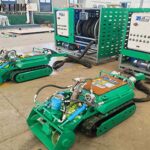
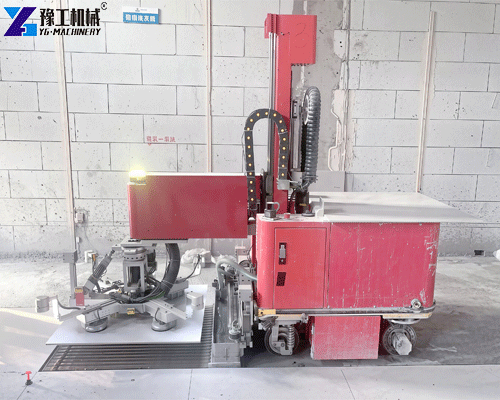
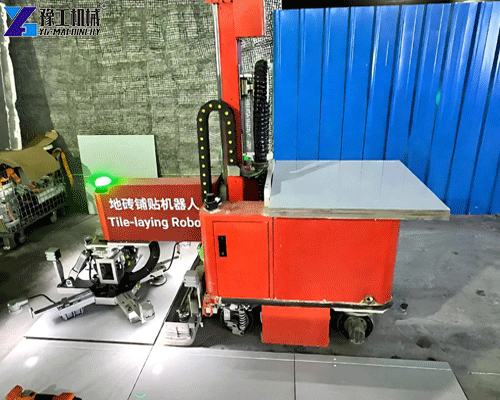
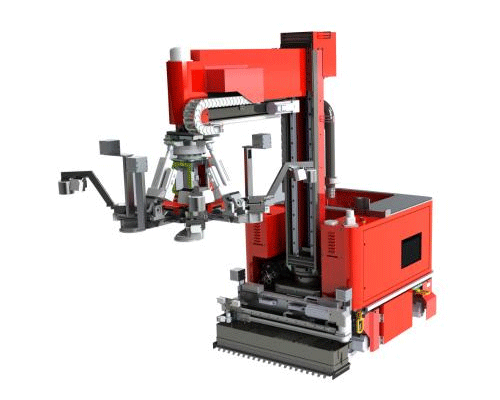
The YG Tile Laying Robot is an intelligent construction machine designed to automate floor tile installation in large commercial, residential, and public building projects. Combining laser SLAM navigation, deep learning algorithms, an omnidirectional mobile chassis, and a distributed vibration system, it helps construction teams improve installation efficiency while maintaining consistent tile alignment and surface quality.
With a comprehensive working efficiency of up to 20㎡ per hour shift and battery endurance of up to 9 hours, this automatic floor tile laying robot reduces repetitive manual work and dependence on skilled tile installers. It is suitable for airports, railway stations, hotels, schools, commercial buildings, and large residential developments.
Technical Specifications of the Tile Laying Robot
| Item | Specification |
|---|---|
| Equipment Type | Automatic Tile Laying Robot |
| Overall Dimensions | 1150 × 750 × 1780 mm |
| Weight | 600 kg (empty) |
| Working Mode | Intelligent Operation |
| Navigation | Laser SLAM Navigation |
| Mobile Chassis | Omnidirectional Mobile Chassis |
| Comprehensive Efficiency | Up to 20㎡ / h |
| Battery Endurance | Up to 9 hours |
| Communication | 5G / WiFi |
| Alignment Accuracy | ≤0.5mm |
| Hollow Tile Rate | <3% |
| Vibration System | Distributed Vibration System |
| Intelligent Technology | Deep Learning Algorithms |
| Adjustment System | Self-Adaptive Adjustment |
| Positioning | Automatic Location Recognition |
| Path Planning | Automatic Path and Task Planning |
| Tile Compatibility | Various Tile Sizes |
| Edge Installation | Supported |
| BIM Modeling | Not Required |
| Monitoring | Cloud Platform Construction Monitoring |
| Operation | Human-Computer Interaction |
Why Are More Contractors Choosing Tile Laying Robots?
Traditional floor tile installation requires considerable manual labor. Workers must repeatedly position tiles, maintain consistent spacing, adjust alignment, and ensure proper bonding with the floor.
For large construction projects, these tasks create several challenges:
- High labor requirements: Large floor areas require multiple experienced tile installers, increasing labor and management costs.
- Inconsistent installation quality: Differences in worker experience can result in uneven surfaces, misaligned tiles, and hollow spots.
- Slow construction progress: Repetitive manual operations make it difficult to maintain high productivity across extensive floor areas.
- Difficult quality control: Maintaining consistent tile alignment and installation quality requires continuous supervision.
A robotic floor tiling system helps address these problems by automating repetitive positioning and installation operations.
Instead of relying entirely on manual tile placement, contractors can use intelligent navigation, automatic task planning, and self-adaptive adjustment to improve construction consistency and reduce manual workload.
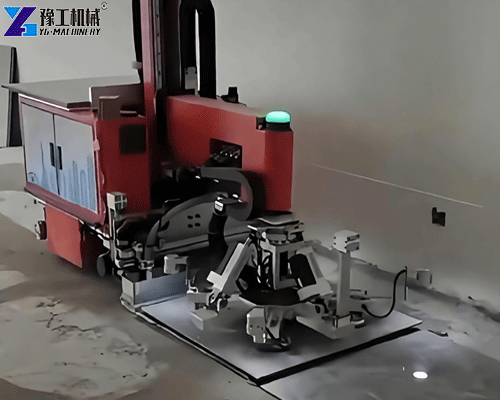
How Does an Automatic Floor Tile Laying Robot Work?
The YG automatic tile laying robot integrates intelligent navigation, positioning, movement, and vibration technologies to perform floor tile installation.
Its operation combines environmental recognition, automatic path planning, tile positioning, and installation adjustment.
1. Laser SLAM Navigation and Automatic Positioning
The robot uses Laser SLAM navigation to recognize its surroundings and determine its working position.
Deep learning algorithms support intelligent recognition and positioning, helping the robot adapt to different construction layouts.
Key benefits include:
- Automatic location recognition
- Intelligent environmental positioning
- No BIM modeling required
- Flexible operation in different construction areas
2. Automatic Path Planning and Omnidirectional Movement
Large floor tiling projects often involve open spaces, corridors, and different working areas. Frequent manual repositioning can reduce construction efficiency.
The robot features an omnidirectional mobile chassis that supports flexible movement on construction sites.
Its automatic path and task planning system calculates working routes and installation tasks, helping reduce unnecessary movement and improve operational efficiency.
3. Intelligent Tile Alignment and Self-Adaptive Adjustment
Maintaining consistent tile alignment is essential for professional floor installation.
The robot uses intelligent positioning and self-balancing calculations to adjust tile placement and maintain alignment accuracy.
Its self-adaptive adjustment system also helps accommodate floor conditions that do not require high-precision ground preparation.
This is particularly useful for large projects where maintaining consistent installation quality across extensive floor areas can be challenging.
4. Distributed Vibration for Better Tile Installation
Air pockets between tiles and adhesive can lead to hollow spots and affect the long-term quality of floor installation.
The distributed vibration system helps improve tile installation consistency by supporting more uniform contact between tiles and the bonding layer.
Combined with intelligent positioning and adjustment, this system helps reduce the risk of hollow tiles and improve overall installation quality.
5. Intelligent Operation and Wireless Communication
The tile laying robot features an intelligent operating system and supports 5G and WiFi communication.
Combined with human-computer interaction and cloud platform construction monitoring, these functions help operators monitor equipment operations and construction progress.
Its built-in battery provides up to 9 hours of endurance, supporting continuous operation during a typical construction shift and reducing interruptions caused by frequent charging.
For construction projects requiring additional floor preparation, an automatic floor self-leveling robot can be used to improve floor flatness before tile installation. Combining automated floor leveling with robotic tile laying helps construction teams streamline different stages of floor construction.
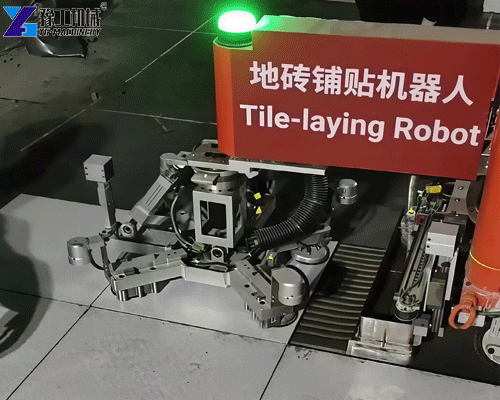
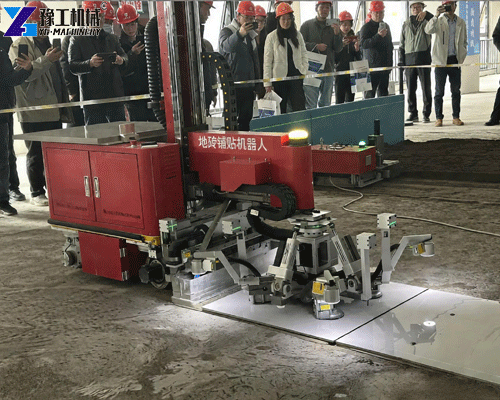
Key Advantages of the YG Tile Laying Robot
1.Higher Efficiency for Large Floor Areas
For airports, hotels, commercial buildings, and other large construction projects, floor tiling involves extensive repetitive operations.
The YG tile laying robot achieves a comprehensive working efficiency of up to 20㎡ per hour shift, helping contractors improve floor installation productivity and manage project schedules more effectively.
By automating repetitive positioning and laying tasks, it reduces manual workload and supports more efficient workforce organization.
2.More Consistent Tile Alignment and Surface Quality
Uneven tile surfaces, inconsistent spacing, and hollow spots are common quality concerns in manual floor installation.
The robot combines intelligent positioning, self-balancing calculations, and distributed vibration to improve installation consistency.
Its key performance indicators include:
- Tile alignment accuracy: ≤0.5mm
- Hollow tile rate: <3%
These capabilities help construction teams achieve more consistent floor tile installation quality across large working areas.
3.Reduced Dependence on Manual Labor
Finding and managing experienced tile installers can be challenging, especially for contractors handling multiple large projects.
An automatic tile installation machine takes over repetitive operations, reducing manual workload and dependence on traditional installation teams.
Workers can focus more on site coordination, material preparation, edge details, and other tasks that require human assistance.
This helps contractors improve labor utilization and explore more efficient construction methods.
4.Long Battery Endurance for Continuous Operation
Frequent charging can interrupt construction operations and affect daily productivity.
The YG tile laying robot is equipped with a battery system offering up to 9 hours of endurance. This allows the machine to support extended daily operations without frequent charging interruptions.
Combined with its intelligent operating system and wireless communication capabilities, it is designed for practical use on modern construction sites.
5.Adaptable to Different Tile Sizes and Floor Conditions
Different construction projects use different ceramic tile dimensions and floor layouts.
The YG tile laying robot is designed to accommodate various tile sizes and supports edge-tile installation.
Its self-adaptive adjustment capabilities also help it operate on floors that do not require high-precision preparation, providing greater flexibility for practical construction environments.
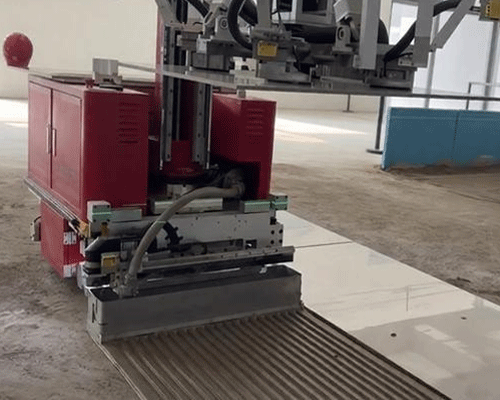
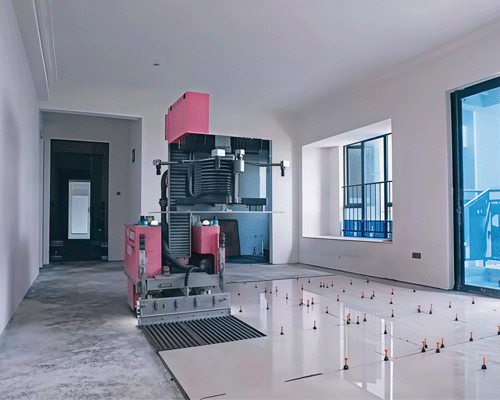
Applications of the Automatic Tile Laying Robot
The tile laying robot is particularly suitable for large, relatively open floor areas where repeated tile installation is required. It can support a variety of commercial, public, and residential construction projects.
1.Airports and Railway Stations
Airports, high-speed railway stations, and railway terminals typically involve extensive floor areas and demanding construction schedules.
Automated tile installation helps construction contractors improve productivity and maintain consistent tile alignment across large public spaces.
2.Hotels and Commercial Buildings
Hotel lobbies, shopping malls, office buildings, and commercial facilities often require large areas of ceramic floor tiles.
The robot helps contractors handle repetitive installation tasks while improving the consistency of floor surfaces in high-traffic public areas.
3.Schools and Public Buildings
Schools, hospitals, government buildings, and other public facilities often involve standardized floor layouts across multiple rooms and corridors.
The automatic tile laying robot can help construction teams improve installation efficiency and maintain consistent workmanship across these projects.
4.Residential Buildings
Large residential developments and apartment projects often require repeated floor tile installation in living rooms, dining areas, and other interior spaces.
The robot helps reduce repetitive manual operations and supports more efficient floor tiling across multiple residential units.
Tile Robot Price: What Should You Consider Before Buying?
The price of a tile laying robot depends on its automation capabilities, navigation technology, working efficiency, battery configuration, supported tile sizes, and overall equipment configuration.
However, the initial equipment cost is only one part of the investment.
For construction contractors, the more important consideration is the overall cost of completing each square meter of floor tiling.
When evaluating an automatic floor tile laying robot, consider the following factors:
- Working efficiency: Evaluate the actual installation area the robot can complete during an 8-hour shift.
- Labor requirements: Consider how many workers are needed for material preparation, equipment operation, and edge installation.
- Battery endurance: Check whether the operating time can support your daily construction schedule.
- Tile compatibility: Confirm that the machine supports the tile dimensions and installation requirements of your projects.
- Construction conditions: Assess floor layouts, working space, and site conditions before selecting the equipment.
- Long-term operating costs: Consider maintenance, consumables, training, and equipment service requirements.
For contractors undertaking large commercial and public construction projects, automated tile installation can provide long-term value by improving labor utilization, construction efficiency, and installation consistency.
FAQ About Tile Laying Robots
1. What is a tile laying robot?
A tile laying robot is an automated construction machine designed to perform or assist with floor tile installation. It uses intelligent navigation, positioning, and mechanical systems to automate repetitive tile placement operations and improve installation efficiency.
2. How much floor area can a tile laying robot install in one day?
The YG tile laying robot has a comprehensive working efficiency of up to 20㎡ per hour shift. Actual productivity depends on tile dimensions, floor layout, material preparation, and construction conditions.
3. How long can an automatic tile laying robot operate on one charge?
The YG tile laying robot provides up to 9 hours of battery endurance, supporting extended daily construction operations.
4. Can a tile laying robot work with different tile sizes?
Yes. The YG robot is designed to accommodate various tile sizes and supports edge-tile installation, making it suitable for different floor tiling projects.
5. Does a tile laying robot require BIM modeling?
No. The YG tile laying robot uses Laser SLAM navigation and intelligent recognition algorithms for positioning and path planning. BIM modeling is not required.
6. Can a tile laying robot reduce labor costs?
Yes. By automating repetitive tile positioning and installation operations, the robot can reduce manual workload and dependence on skilled tile installers. Actual labor savings depend on project size, site conditions, and workforce organization.
7. Is a tile laying robot suitable for large commercial projects?
Yes. It is particularly suitable for large and relatively open floor areas in airports, railway stations, hotels, schools, commercial buildings, and public construction projects.
Conclusion
The YG Tile Laying Robot provides an intelligent approach to modern floor tile installation. By combining laser SLAM navigation, deep learning algorithms, automatic path planning, and distributed vibration technology, it helps address common challenges in traditional tiling, including high labor requirements, inconsistent alignment, and uneven installation quality.
With a comprehensive working efficiency of up to 20㎡ per hour shift, 9-hour battery endurance, and flexible omnidirectional movement, it offers a practical automation solution for large-scale floor tiling applications.
As construction projects increasingly focus on labor efficiency and installation quality, automatic tile laying robots are becoming a valuable option for modern commercial, public, and residential construction.